GEOTECHNICAL ENGINEERING
LEXINGTON
HomeLaboratoryTriaxial test

Triaxial Testing in Lexington: Advanced Soil Strength Under Controlled Conditions

Evidence-based design. Reliable delivery.

LEARN MORE

A six-story mixed-use development off Nicholasville Road hit a snag last fall. The geotechnical report flagged saturated clay lenses at 20 feet, and the structural engineer refused to sign off on the footing design without drained shear strength parameters. That is exactly when a triaxial test series becomes non-negotiable. In Lexington, where the Eden shale and limestone residuum create unpredictable transition zones between stiff and soft layers, total stress parameters from unconfined compression alone are not enough. The triaxial test isolates pore pressure response under multi-stage loading, giving the design team effective friction angles and cohesion intercepts they can actually use in slope stability models and deep foundation calculations. We run the full ASTM D4767 procedure in our accredited lab, consolidating specimens to in-situ stress states before shearing them at controlled strain rates. When the report landed on the engineer’s desk, the footing geometry was approved within 48 hours. For projects near the Kentucky River bluffs, combining triaxial data with a slope stability analysis becomes the logical next step.

A single triaxial test series on saturated Lexington clay gives you the effective friction angle that governs long-term bearing capacity—skip it, and your safety factor is just a guess.
Our service areas

How we work

ASTM D4767 governs the consolidated-undrained triaxial compression test on cohesive soils, and it is the standard we reference on every Lexington project where pore pressure measurement matters. The procedure requires back-pressure saturation until Skempton’s B parameter exceeds 0.95, a detail that smaller labs often skip but that directly affects the reliability of effective stress paths. We prepare specimens trimmed from Shelby tube samples collected across Fayette County, consolidate them under effective stresses matching the proposed foundation depth, and shear them at axial strain rates slow enough to allow pore pressure equalization. The output includes Mohr-Coulomb envelopes for both total and effective stress conditions, plus stress-strain curves that reveal strain-softening behavior common in the local Garrard Siltstone residual soils. For granular materials where drainage is critical, we run consolidated-drained (CD) triaxial tests that pair naturally with CPT soundings when profiling alluvial deposits along the Town Branch corridor. Every test report includes B-value verification, consolidation curves, and p-q diagrams so the geotechnical engineer can validate the failure envelope independently.
Triaxial Testing in Lexington: Advanced Soil Strength Under Controlled Conditions
Technical reference — Lexington

Local geotechnical context

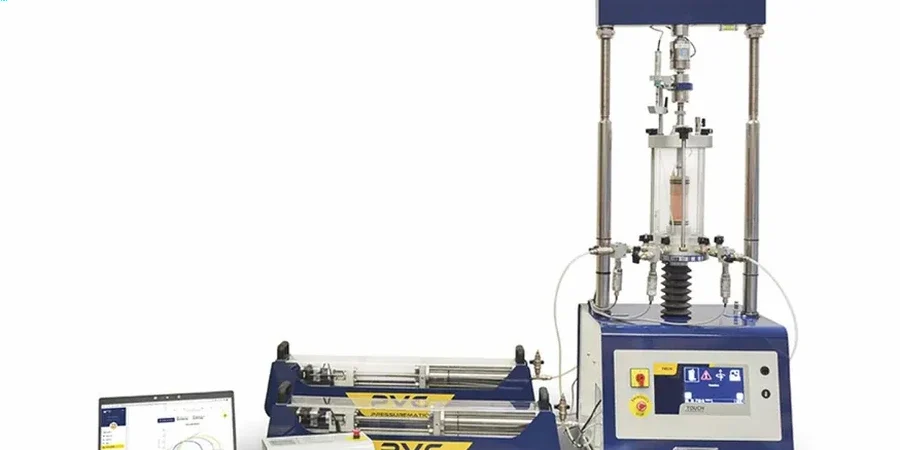
The triaxial cell itself is a machined stainless steel chamber rated for 150 psi confining pressure, with a pneumatic bladder system that applies isotropic stress to a membrane-wrapped soil cylinder sitting between two porous stones. When a Lexington contractor sends us shelby tube samples from a site near Hamburg Pavilion where the upper 15 feet is stiff fat clay over karst-weathered limestone, the risk of mischaracterizing the shear strength is real. A standard unconfined compression test on the same material might show a peak deviator stress of 45 psi, but without pore pressure measurement during shear you cannot separate the effective stress component from the excess pore pressure generated during loading. That missing piece leads to overestimating the bearing capacity of shallow footings, and in Lexington’s variable moisture conditions—where clay can be dry and cracked in August and fully saturated in March—the consequence is differential settlement that appears two years after construction. The triaxial test eliminates that blind spot by measuring pore pressure at the base and mid-height of the specimen throughout the shear phase, producing effective stress Mohr circles that represent the soil skeleton behavior independent of water pressure.

Need a geotechnical assessment?

Reply within 24h.

Email: contact@geotechnicalengineering.biz

Regulatory framework

ASTM D4767-11: Standard Test Method for Consolidated Undrained Triaxial Compression Test for Cohesive Soils, ASTM D7181-20: Standard Test Method for Consolidated Drained Triaxial Compression Test for Soils, ASTM D4220/D4220M-14: Standard Practices for Preserving and Transporting Soil Samples, IBC 2021 Section 1803: Geotechnical Investigations, ASCE 7-22 Minimum Design Loads and Associated Criteria for Buildings and Other Structures

Reference parameters

ParameterTypical value
Applicable StandardASTM D4767 (CU), ASTM D7181 (CD)
Specimen Diameter1.4 in to 2.8 in (35 mm to 71 mm)
Maximum Confining PressureUp to 150 psi (1,034 kPa)
Back-Pressure Saturation TargetSkempton B-value ≥ 0.95
Axial Strain Rate (CU on clay)0.05% to 0.5% per minute
Measured Parametersc’, φ’, cₓ, φₓ, E₅₀, pore pressure coefficient Aₓ
Specimen ConditionUndisturbed (Shelby tube) or remolded per request
Reporting FormatMohr circles, p-q diagrams, stress-strain curves, pore pressure vs. strain

Questions and answers

How much does a triaxial test series cost in Lexington?

A standard three-specimen CU triaxial test series in Lexington runs between $1,890 and $2,950, depending on the number of confining stress stages, whether you need effective stress (with pore pressure measurement) or total stress only, and how quickly you need the report. Multi-stage tests on a single specimen fall on the lower end of that range. The price includes sample trimming, back-pressure saturation with B-value verification, consolidation monitoring, shear phase at controlled strain rate, and the full report with Mohr circles and p-q diagrams. Expedited turnaround adds a surcharge, but standard delivery is 8 to 12 business days from sample acceptance.

What is the difference between a CU and CD triaxial test?

In a consolidated-undrained (CU) test under ASTM D4767, the specimen is consolidated under a confining pressure, then sheared with the drainage valves closed so pore pressure can be measured. This gives you effective stress parameters (c’ and φ’) that control long-term stability. In a consolidated-drained (CD) test under ASTM D7181, the specimen is sheared slowly with drainage valves open so no excess pore pressure develops. That yields drained strength parameters used for sandy soils or when loading is slow enough that water can dissipate. For Lexington’s saturated residual clays, CU testing is the default; CD testing applies to the granular alluvium near the Kentucky River.

What size sample do you need for a triaxial test in Lexington?

We need undisturbed Shelby tube samples with a minimum diameter of 2.8 inches (71 mm) and a length of at least 6 inches. The specimen is trimmed to a 2:1 height-to-diameter ratio per ASTM D4767. Samples must be sealed with wax or plastic caps immediately after extraction and kept at field moisture content during transport. For Lexington projects where Shelby tube recovery is poor—common in the weathered shale zones east of I-75—contact us before drilling so we can coordinate sample preservation with your drilling contractor.

Location and service area

We serve projects in Lexington and surrounding areas.

View larger map