GEOTECHNICAL ENGINEERING
LEXINGTON
HomeLaboratoryGrain size analysis (sieve + hydrometer)

Grain Size Analysis (Sieve + Hydrometer) in Lexington, KY

Evidence-based design. Reliable delivery.

LEARN MORE

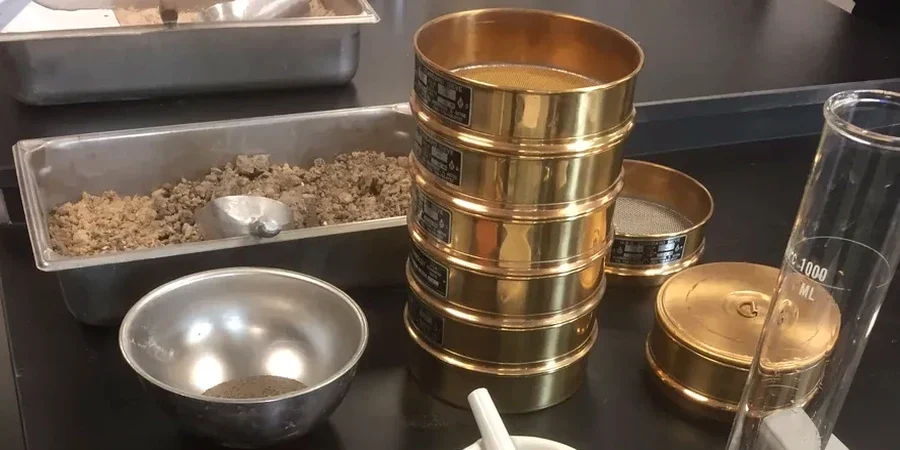
Lexington sits on a karst landscape where the Ordovician Lexington Limestone shapes everything below grade. With over 320,000 residents in the metro area and a construction market driven by medical campuses and infill development, knowing exactly what you're digging into is non-negotiable. A proper grain size analysis tells you more than just sand and gravel percentages—it reveals how water will move through the formation, how the material will compact, and whether those fine-grained residues signal a tricky clay that could swell during wet winters. Our lab runs the full mechanical sieve stack plus hydrometer sedimentation following ASTM D422 and D7928, because skipping the silt-clay fraction in this town is like ignoring the limestone pinnacles beneath the topsoil. When foundation performance depends on drainage behavior, we often pair the particle size curve with an in-situ permeability test to confirm field hydraulic conductivity against lab predictions.

If you don't measure what passes the #200 sieve, you're designing blind—especially on Lexington's clay-rich residuum.
Our service areas

How we work

We recently worked on a multi-story mixed-use project off Nicholasville Road where the contractor was convinced the site was clean sand based on visual inspection alone. The sieve analysis confirmed about 65% sand fraction, but the hydrometer revealed 22% passing the #200 sieve—mostly low-plasticity silt from weathered limestone residuum that Lexington geotechs know all too well. That changed the entire subgrade preparation spec. The grain size distribution curve gives you the full picture: gravel content for drainage blanket design, sand fraction for filter compatibility, and the fines percentage that controls frost susceptibility and compaction moisture sensitivity. For road base sections across Fayette County, we combine this data with a CBR laboratory test to correlate particle size with bearing capacity, ensuring the pavement section won't fail under Kentucky's freeze-thaw cycles.
Grain Size Analysis (Sieve + Hydrometer) in Lexington, KY
Technical reference — Lexington

Local geotechnical context

The Inner Bluegrass region sits in a moderate seismic zone, with USGS hazard maps assigning Lexington a PGA of roughly 0.08–0.12g for the 2% in 50-year event. That's not California, but combined with loose silty sands and a shallow water table that fluctuates in the karst aquifer, it's enough to trigger liquefaction concerns in saturated granular layers. Grain size analysis is the first screening tool—soils with high fines content or well-graded particle distributions are far less susceptible to pore pressure buildup during cyclic loading. Misclassifying a silty sand as clean sand because someone skipped the hydrometer can lead to an overly conservative liquefaction assessment, or worse, a false sense of security. The USCS classification derived from this test feeds directly into bearing capacity calculations, slope stability models, and seepage analyses that govern foundation design across the region.

Need a geotechnical assessment?

Reply within 24h.

Email: contact@geotechnicalengineering.biz

Regulatory framework

ASTM D422 - Standard Test Method for Particle-Size Analysis of Soils, ASTM D7928 - Standard Test Method for Particle-Size Distribution (Gradation) of Fine-Grained Soils Using the Sedimentation (Hydrometer) Analysis, ASTM D6913 - Standard Test Methods for Particle-Size Distribution (Gradation) of Soils Using Sieve Analysis, ASTM D2487 - Standard Practice for Classification of Soils for Engineering Purposes (Unified Soil Classification System), IBC 2021 - International Building Code, Section 1803 Geotechnical Investigations

Reference parameters

ParameterTypical value
Test StandardASTM D422 / D7928 / D6913
Sieve Range3 in (75 mm) down to #200 (75 μm)
Hydrometer Range75 μm down to 0.001 mm (clay fraction)
Sample Mass Required500 g for fine-grained; 5 kg for coarse-grained
Reported ParametersD10, D30, D60, Cu, Cc, % gravel/sand/silt/clay
Minimum SampleDisturbed bag sample; undisturbed not required
Turnaround Time3-5 business days standard; 24-hr rush available

Questions and answers

How much does a grain size analysis cost in Lexington?

A standard sieve analysis with hydrometer typically ranges from US$100 to US$160 per sample, depending on whether we run a full wash sieve or just dry sieving. Expedited turnaround adds a modest surcharge. We provide a firm quote once we know the sample count and project timeline.

How much sample material do you need?

For fine-grained soils like clayey silt, about 500 grams of disturbed material is sufficient. For coarse-grained samples with gravel, we need approximately 5 kilograms to ensure a representative split. We can provide sampling bags and guidance before you mobilize to the site.

What's the difference between a sieve analysis and a hydrometer test?

Mechanical sieves separate particles down to 75 microns (the #200 sieve), which captures sand and gravel fractions. The hydrometer test uses sedimentation principles to measure silt and clay particles smaller than 75 microns. Both are required for a complete particle size distribution curve under ASTM D422 or D7928.

How long does it take to get results?

Standard turnaround is three to five business days from sample receipt. The hydrometer portion requires a 24-hour sedimentation period, which sets the minimum time. We offer a 24-hour rush service for time-sensitive projects when coordinated in advance.

Location and service area

We serve projects in Lexington and surrounding areas.

View larger map