GEOTECHNICAL ENGINEERING
LEXINGTON
HomeGround improvementStone column design

Stone Column Design for Kentucky Karst: Ground Improvement Lexington Contractors Trust

Evidence-based design. Reliable delivery.

LEARN MORE

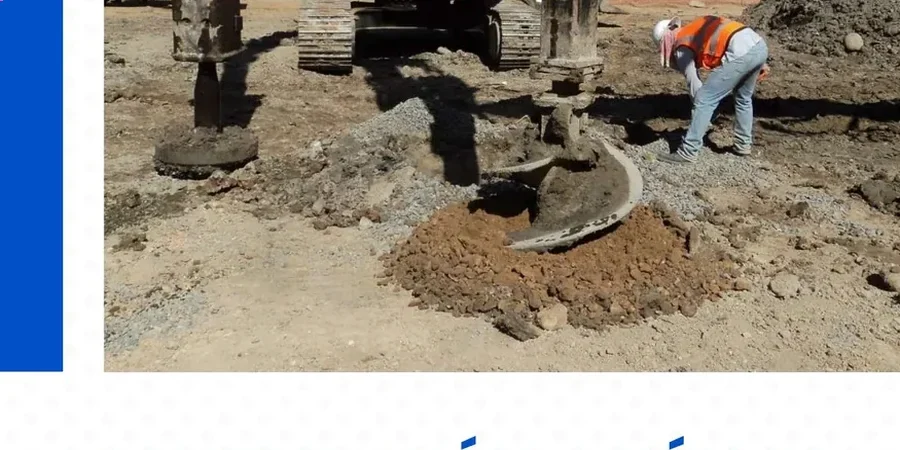
A five-story mixed-use project off Nicholasville Road hit refusal at 12 feet—limestone pinnacles with soft clay pockets between them. The geotech called for over-excavation until the contractor realized they'd be digging to 30 feet in places and still not finding uniform bearing. That's when the structural engineer flagged the need for ground improvement rather than deep foundations, and the conversation shifted to stone columns as a way to bridge the variable karst profile. Our team ran the settlement analysis using the Priebe method with modulus values back-calculated from CPT soundings, and within ten days the contractor had a design package that eliminated 80% of the planned over-excavation. In Lexington's Inner Bluegrass region, where the Lexington Limestone formation creates exactly this kind of erratic bedrock surface, stone column design isn't just a value-engineering option—it's often the difference between a feasible foundation budget and a project that never breaks ground. We combine site-specific CPT testing with modulus degradation curves calibrated to the high-plasticity Maury silt loams that dominate the buildable parcels around Hamburg Pavilion and the Citation Boulevard corridor.

Stone columns in Lexington karst don't just densify—they bridge, transferring loads past soft pockets to competent limestone without the cost of drilled shafts.
Our service areas

How we work

The Ordovician-age Lexington Limestone beneath Fayette County is notoriously unpredictable, with pinnacle-and-trough topography that can vary 20 vertical feet within a single building footprint. Residual clay infill between rock highs often classifies as CH material with liquid limits above 50 and undrained shear strengths under 800 psf—conditions where vibro-replacement stone columns provide both densification and reinforcement functions. Our design methodology follows FHWA Geotechnical Engineering Circular No. 13 for aggregate pier systems, incorporating unit cell concepts to model the composite behavior of stone and matrix soil under area replacement ratios typically ranging from 10% to 35% depending on the structural load demand. We specify open-graded crushed limestone aggregate meeting Kentucky Transportation Cabinet gradation No. 57 or No. 67, which bonds well with the native calcareous clay and maintains drainage capacity even under long-term consolidation. For projects near the Kentucky River palisades where slope stability enters the picture, we integrate slope stability analysis directly into the column layout to verify global failure surfaces won't daylight through the improved zone. Every design package includes construction sequencing, mandrel type recommendations, and post-installation modulus verification via plate load testing per ASTM D1194.
Stone Column Design for Kentucky Karst: Ground Improvement Lexington Contractors Trust
Technical reference — Lexington

Local geotechnical context

The most expensive mistake we see in Lexington karst ground improvement is specifying stone columns without running a thorough sinkhole potential assessment first. Fayette County has documented karst features including the McConnell Springs area and numerous mapped sinkholes in the Hamburg and Polo Club Boulevard zones, and installing vibro-replacement equipment over an incipient collapse feature can trigger sudden subsidence that damages adjacent structures and voids the contractor's liability coverage. A proper design sequence requires electrical resistivity profiling or MASW survey lines across the building pad to identify air-filled voids before column layout begins. We've also seen projects where the designer applied a uniform 20% replacement ratio across the entire footprint, ignoring the fact that the soft clay thickness varies from 3 feet to 28 feet within the same pad—the resulting differential settlement under sustained dead load reached 1.5 inches at the column line, cracking architectural finishes that cost more to repair than the original ground improvement contract. In Lexington's seismic environment, where ASCE 7-22 assigns Site Class D to most of the urban corridor, we factor in the potential for excess pore pressure generation in saturated clay lenses during the design earthquake, verifying that stone column drainage capacity can dissipate pressures before cyclic softening develops.

Need a geotechnical assessment?

Reply within 24h.

Email: contact@geotechnicalengineering.biz

Regulatory framework

ASCE 7-22 (Minimum Design Loads for Buildings), IBC 2021 Chapter 18 (Soils and Foundations), ASTM D1586 (Standard Penetration Test), ASTM D2487 (Soil Classification), ASTM D1194 (Plate Load Test), FHWA GEC 13 (Ground Modification Methods)

Reference parameters

ParameterTypical value
Design methodPriebe (FHWA GEC 13) with cavity expansion verification
Typical column diameter24–36 inches (wet top-feed or bottom-feed vibro-replacement)
Area replacement ratio range10%–35% depending on structural load and native soil stiffness
Aggregate specificationKYTC No. 57 or No. 67 crushed limestone, LA abrasion < 40%
Post-installation verificationPlate load test (ASTM D1194) + SPT at column center and edge
Settlement reduction target60%–80% reduction vs. untreated footing on karst clay
Depth capability (Lexington karst)Typically 15–40 ft, terminated on limestone refusal

Questions and answers

What does stone column design cost for a Lexington commercial project?

For a typical Lexington commercial building pad requiring stone column ground improvement, the design package—including site-specific settlement analysis, column layout drawings, aggregate specification, and QA/QC protocols—ranges from US$1,630 to US$5,060 depending on the building footprint size, number of column locations, and whether geophysical karst surveys are included. Projects with complex variable rock surface topography or those near mapped sinkhole zones fall toward the upper end due to the additional cross-section analysis required.

How do stone columns perform in Lexington's karst limestone conditions?

Stone columns in karst environments serve a dual purpose: they densify and reinforce the soft residual clay pockets between limestone pinnacles, and they create a composite ground mass that bridges across rock irregularities. In Lexington's Inner Bluegrass geology, where the Lexington Limestone surface can undulate 15 to 20 vertical feet within a single building footprint, the columns are typically terminated on competent rock refusal, creating a load transfer platform that reduces differential settlement to acceptable levels without requiring deep foundation elements at every column line.

What aggregate material is specified for vibro-replacement in central Kentucky?

We specify open-graded crushed limestone meeting Kentucky Transportation Cabinet gradation No. 57 (1-inch to No. 4) or No. 67 (3/4-inch to No. 4), with Los Angeles abrasion loss below 40%. Locally sourced limestone from central Kentucky quarries bonds effectively with the calcareous residual clay matrix common in Fayette County, and the angular particle shape provides superior interlock compared to rounded river gravel, which we avoid in vibro-replacement applications where column stiffness is critical.

How is stone column performance verified after installation in Lexington soils?

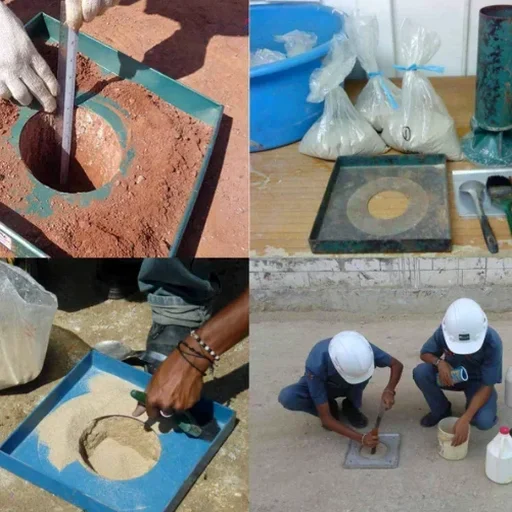
Post-installation verification follows a two-stage approach: modulus verification via plate load testing per ASTM D1194 at a minimum of one test per 5,000 square feet of improved area, and SPT sampling at column centers and midpoints between columns to confirm densification. For critical structures, we also specify cross-hole shear wave velocity testing to verify that the composite ground modulus meets the design assumption. Acceptance criteria are tied to the settlement analysis—if the measured modulus falls below 90% of the design value, additional columns or a load test program is triggered.

Location and service area

We serve projects in Lexington and surrounding areas.

View larger map