GEOTECHNICAL ENGINEERING
LEXINGTON
HomeLaboratoryLaboratory CBR test

Laboratory CBR Testing for Pavement Design in Lexington, KY

Evidence-based design. Reliable delivery.

LEARN MORE

Lexington sits squarely on the Inner Bluegrass region, where the Ordovician Lexington Limestone weathers into high-plasticity clay residuum that can lose 60% of its strength when saturated. Highway 60 and the New Circle Road expansion have repeatedly demonstrated that CBR values below 3% are common in these Maury-McAfee soil complexes, which means the laboratory CBR test is not just a specification checkbox here — it determines whether a pavement section needs chemical stabilization or a full-depth asphalt redesign. The Kentucky Transportation Cabinet’s Standard Specifications for Road and Bridge Construction (2024 edition) requires soaked CBR testing per AASHTO T 193 for all subgrade evaluation, and our Lexington-based team runs these protocols daily, correlating results with the grain-size analysis and Atterberg limits that define the behavior of local residual soils.

A CBR value of 3 versus 6 on Bluegrass clay can mean the difference between 8 inches of aggregate base and 14 inches — and that’s the margin where projects in Fayette County go over budget.
Our service areas

How we work

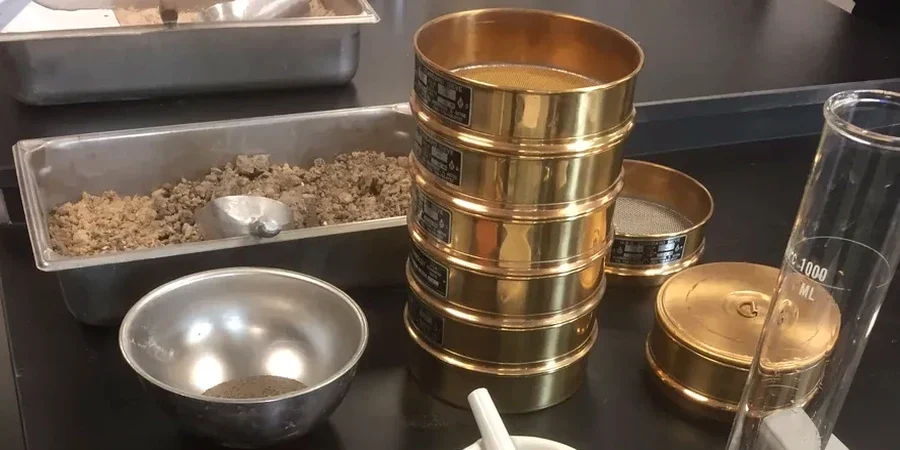
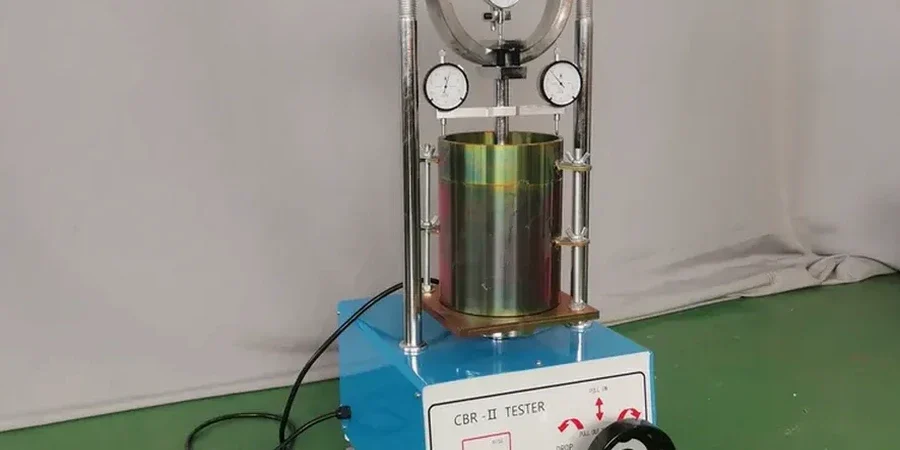
Lexington’s post-1950 expansion from a compact county seat into the Horse Capital of the World placed enormous demand on arterial roads built over phosphatic limestone terrain where sinkholes and pinnacled bedrock create abrupt stiffness transitions. A pavement designed on a uniform CBR assumption fails within three freeze-thaw cycles when the subgrade differential heave exceeds half an inch. Our laboratory CBR procedure replicates field moisture conditions using a 96-hour soaking phase under a 10-pound surcharge, then measures penetration resistance at 0.05 inches per minute through a 1.95-inch piston, exactly as AASHTO T 193 specifies. We routinely pair this test with in-situ permeability measurements because the fractured limestone beneath many Lexington subdivisions allows rapid groundwater migration that skews soaked CBR values if not accounted for in the pavement structural number calculation.
Laboratory CBR Testing for Pavement Design in Lexington, KY
Technical reference — Lexington

Local geotechnical context

A six-story mixed-use building off Nicholasville Road ran into foundation trouble in 2022 when the parking lot pavement began alligator cracking within eight months of opening. The original geotechnical report had relied on DCP correlations that overestimated the subgrade CBR by nearly 40% in the McAfee clay zone. When we ran laboratory CBR tests on Shelby tube samples from the same depth, the soaked values came back at 2.8% — far below the 5% assumed in the pavement design. The fix required milling the entire 4-inch asphalt layer, lime-treating the upper 12 inches of subgrade, and repaving at a cost exceeding $180,000. The lesson for Lexington developers is unambiguous: field index tests cannot substitute for a properly soaked laboratory CBR when the subgrade is a high-plasticity residual clay that swells 3 to 5% under saturation.

Need a geotechnical assessment?

Reply within 24h.

Email: contact@geotechnicalengineering.biz

Regulatory framework

AASHTO T 193: Standard Method of Test for CBR of Laboratory-Compacted Soils, AASHTO T 180: Standard Method of Test for Moisture-Density Relations of Soils Using a 10-lb Rammer and an 18-in Drop, KYTC Standard Specifications for Road and Bridge Construction (Section 207: Subgrade Preparation), ASTM D1883: Standard Test Method for CBR of Laboratory-Compacted Soils (used interchangeably with AASHTO T 193), AASHTO Guide for Design of Pavement Structures (1993, with 1998 supplement)

Reference parameters

ParameterTypical value
Test standardAASHTO T 193 (soaked CBR)
Specimen preparationModified Proctor (AASHTO T 180) at optimum moisture
Soaking period96 hours with swell measurement
Surcharge weight10 lb minimum (simulates overlying pavement)
Penetration piston diameter1.954 inches (49.6 mm)
Penetration rate0.05 in/min
Typical Lexington subgrade CBR (A-6/A-7-6 clay)2.5 to 5.5 (soaked)
Report turnaround (standard)48 hours from sample receipt

Questions and answers

What does a laboratory CBR test cost in Lexington?

A standard soaked CBR test per AASHTO T 193 on a single sample runs between US$110 and US$170, depending on whether we’re testing a remolded specimen from a bulk sample or an undisturbed Shelby tube. A full subgrade characterization package with three CBR points, Proctor compaction, Atterberg limits, and grain-size distribution typically falls in the US$190 to US$240 range. Projects requiring expedited 24-hour turnaround carry a modest surcharge.

Why can’t I just use DCP or a Clegg hammer instead of running a lab CBR test?

The Dynamic Cone Penetrometer and Clegg Impact Hammer are useful for construction quality control and rapid screening, but both devices correlate CBR through empirical equations that assume granular soil behavior. Lexington’s Maury-McAfee clays are fine-grained, high-plasticity soils where the DCP-CBR correlation can overpredict strength by 30 to 50%, as KYTC Research Report KTC-05-28 documented. A soaked laboratory CBR test eliminates this uncertainty by measuring actual penetration resistance under controlled moisture conditions that replicate the worst-case subgrade saturation scenario.

How long does it take to get results from a CBR test in your Lexington laboratory?

Standard turnaround is 48 hours from sample receipt, which includes specimen compaction, the 96-hour soaking period, and penetration testing. For time-sensitive projects, we can run unsoaked CBR as a preliminary indicator within 24 hours, but the soaked value is what KYTC and most Lexington building officials require for pavement design submittals. We always recommend budgeting five working days from sampling to final report to account for soil preparation and documentation.

Location and service area

We serve projects in Lexington and surrounding areas.

View larger map