GEOTECHNICAL ENGINEERING
LEXINGTON
HomeFoundationsPile foundation design

Deep Foundation Design in Lexington, KY

Evidence-based design. Reliable delivery.

LEARN MORE

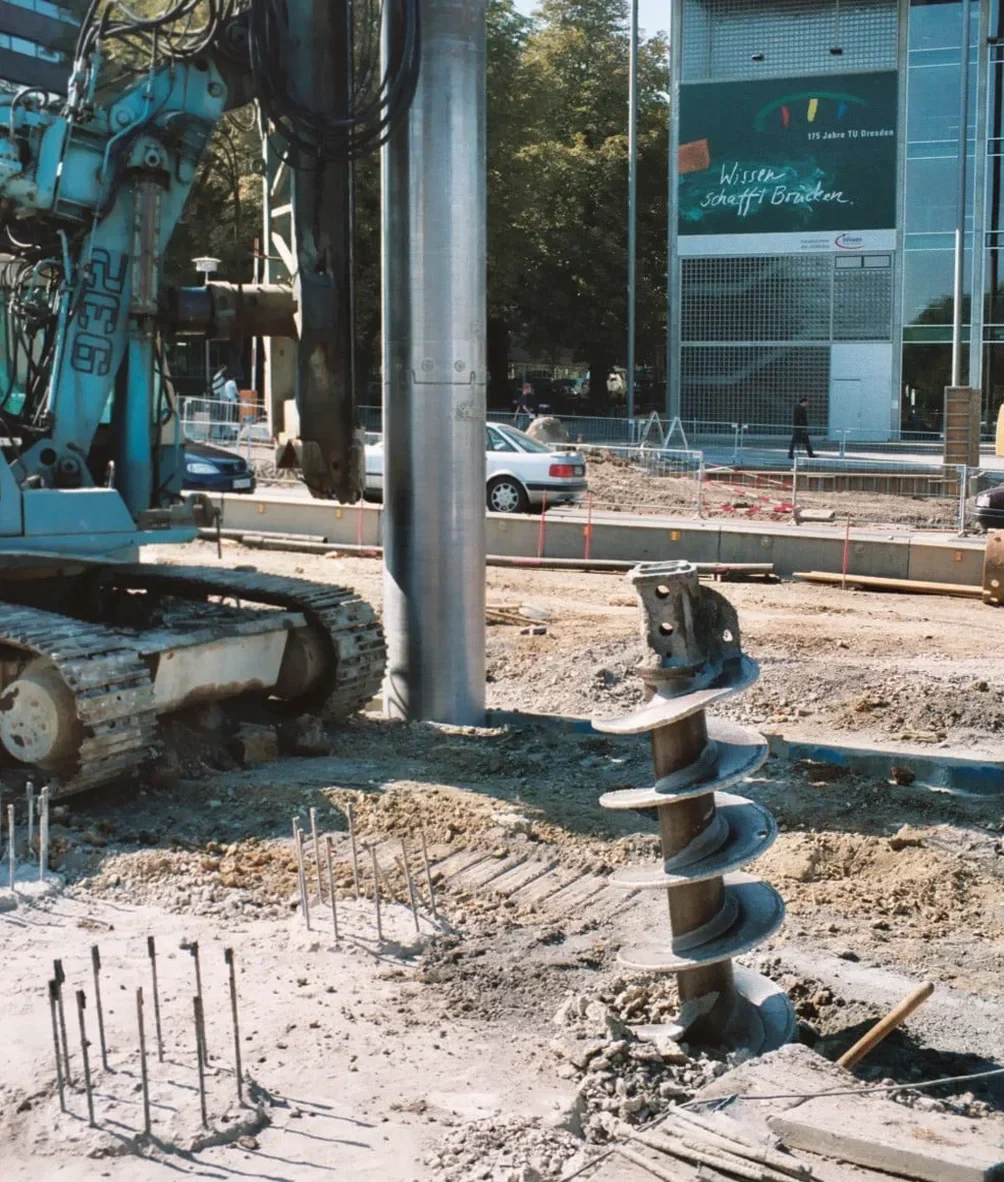
The rig arrives on-site with a hollow-stem auger and an automatic SPT hammer, ready to punch through Lexington's stiff residual clays until refusal on the Lexington Limestone. In this part of Fayette County, the Mississippian-age bedrock rarely exceeds 30 to 40 feet below grade, but the transition zone between the weathered clay and the pinnacled rock demands careful logging — a single boulder mistaken for refusal can compromise an entire pile group. Our team correlates each drive with the ASTM D1586 standard, then feeds the N-values into a load-transfer analysis that accounts for the slickensided clay seams common to the Inner Bluegrass. When the stratigraphy gets ambiguous, we supplement the borehole data with a cone penetration test to map the continuous strength profile without losing the subtle pore-pressure signature that signals a perched water table within the limestone fractures.

In Lexington's karst, pile design isn't about finding rock — it's about proving the rock you found doesn't have a soft seam three feet below the tip.
Our service areas

How we work

Lexington sits squarely on the Lexington Limestone formation, an Ordovician carbonate unit that weathers into a stiff, low-plasticity silty clay with a swelling potential that surprises out-of-town contractors. The depth to competent bedrock varies dramatically — sometimes 15 feet near the Kentucky River palisades, sometimes over 60 feet in the buried valley sections north of New Circle Road. That variability means a uniform pile tip elevation is rarely practical; instead, we design for variable-length piles with a refusal criterion tied to the IBC and ASCE 7 load combinations. For structures that push column loads above 200 kips, the pile-to-cap connection must be detailed to handle the eccentric moment induced by wind on the broad, exposed elevations common in the Bluegrass commercial corridors. Where the soil profile shows a sharp drop in N60 below 10 blows per foot, we integrate a liquefaction assessment to rule out strength loss during the long-period shaking that can travel up the New Madrid seismic zone, even though Lexington sits outside the highest-hazard contours.
Deep Foundation Design in Lexington, KY
Technical reference — Lexington

Local geotechnical context

A four-story mixed-use building on South Broadway hit refusal at 22 feet and the contractor called it bedrock. Core samples two weeks later proved it was a detached limestone float in a clay matrix — the real bearing stratum was at 41 feet. The delay cost the project six figures in change orders and liquidated damages. In Lexington's karst, pinnacled rock profiles are the rule, not the exception, and a pile that bears on a thin capstone over a solution cavity will settle abruptly once the roof collapses under sustained load. The same mechanism threatens pile groups where adjacent tips terminate at different elevations; differential settlement can twist the superstructure and crack partition walls before the certificate of occupancy is issued. Our approach mandates at least one rock core per critical pile cluster, advancing 10 feet below the proposed tip elevation, to confirm the limestone is continuous and free of the clay-filled fissures that riddle the Cynthiana and Lexington Limestone members.

Need a geotechnical assessment?

Reply within 24h.

Email: contact@geotechnicalengineering.biz

Explanatory video

Regulatory framework

IBC 2024 Chapter 18 (Soils and Foundations), ASCE 7-22 Minimum Design Loads for Buildings, ASTM D1586 Standard Test Method for SPT and Split-Barrel Sampling, ASTM D2487 Standard Practice for Classification of Soils, FHWA GEC-10 Drilled Shafts: Construction Procedures and Design Methods

Reference parameters

ParameterTypical value
Typical pile type in Inner BluegrassDrilled shaft or driven H-pile with rock socket
Design bedrock elevation range15 ft to 60+ ft below grade
Governing load standardIBC Chapter 18 / ASCE 7-22
SPT N60 refusal criterion50 blows per 6 inches in claystone/limestone
Soil-pile adhesion in stiff clay (α method)0.45 to 0.60 per FHWA GEC-10
Minimum rock socket length3x pile diameter, minimum 4 ft
Required subsurface exploration depth20 ft below deepest pile tip or 2x pile group width

Questions and answers

What does a pile foundation design package cost for a typical Lexington commercial building?

For a commercial structure in Lexington with a footprint between 5,000 and 20,000 square feet, a complete pile foundation design package — including the geotechnical report, capacity calculations, rock socket details, and the engineer's stamped drawings — typically ranges from US$1,470 to US$5,860. The spread depends on the number of pile groups, whether rock coring is required, and the complexity of the lateral load analysis.

Why does Lexington's limestone cause so many pile design problems?

The Lexington Limestone is riddled with solution channels and clay-filled fissures that create a pinnacled rock surface — imagine an irregular landscape of buried spires and troughs. A pile tip that lands on a thin limestone bridge over a cavity can punch through under load, and two piles in the same group can hit competent rock at elevations 10 or 15 feet apart, causing differential settlement that cracks the structure above.

Do you need a rock core for every pile on a Lexington site?

Not every individual pile, but we recommend at least one rock core per critical pile cluster — typically one per 2,500 square feet of building footprint — to verify the continuity of the Lexington Limestone below the tip. The core should extend a minimum of 10 feet below the deepest pile tip elevation to rule out cavities or soft seams that would invalidate the end-bearing assumption.

How deep do piles typically go in Fayette County?

Depth to competent limestone in Fayette County ranges from roughly 15 feet near the Kentucky River palisades to over 60 feet in the buried valley sections north of New Circle Road. Most commercial projects in central Lexington encounter bedrock between 25 and 40 feet, but we never set a uniform tip elevation — each pile is designed with a refusal criterion tied to the N60 blow count and confirmed by rock core data.

Location and service area

We serve projects in Lexington and surrounding areas.

View larger map