GEOTECHNICAL ENGINEERING
LEXINGTON
HomeIn-Situ TestingField density test (sand cone method)

Field Density Testing in Lexington: Sand Cone Method for Reliable Compaction Control

Evidence-based design. Reliable delivery.

LEARN MORE

The soils beneath a construction site in Chevy Chase rarely match what you'll find over in the Hamburg Pavilion area. Lexington's geology shifts dramatically across short distances, from deep residual clays derived from the Ordovician limestone bedrock to pockets of alluvial silts tracing historic creek beds. This variability is precisely why field density verification isn't just a box to check. It's the only way to confirm that the soil you're building on actually meets the engineered compaction requirements. A laboratory Proctor curve tells you the maximum dry density achievable under controlled conditions. The field test tells you if the contractor's roller and moisture conditioning achieved it in the real world. We apply the sand cone method per ASTM D1556 across Fayette County because it remains the most direct and defensible measure of in-place density. For sites where deeper stratigraphic control is needed, we often recommend pairing the test with SPT drilling to verify that the subsurface conditions match the geotechnical baseline before compaction even begins.

A Proctor curve is theoretical. A density gauge is indirect. The sand cone gives you the physical volume and mass of soil removed from your compacted lift.
Our service areas

How we work

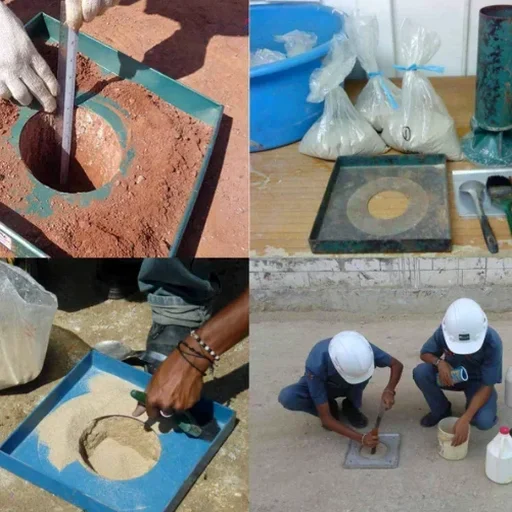
Much of central Lexington sits atop the Lexington Limestone formation, which weathers into a stiff, plastic clay locally known for its high shrink-swell potential. Achieving uniform compaction in this material requires precise moisture control. The sand cone test gives us a single, unambiguous number: the in-place dry density and the resulting percent compaction relative to the laboratory standard. Our procedure uses calibrated Ottawa sand meeting ASTM C778 gradation. The apparatus includes a one-gallon threaded jar, a metal base plate with a 6.5-inch diameter opening, and a precision-engineered cone valve. We excavate a test hole approximately 4 inches deep, carefully recover all the soil, seal it immediately to prevent moisture loss, and weigh it on a calibrated field scale. The volume of the hole is then measured by filling it with sand of known density from the apparatus. The calculation yields wet density, and a simple lab moisture content determination converts that to dry density. On large commercial pads near Citation Boulevard, we often see specifications calling for 95% or 98% of modified Proctor maximum density. The sand cone method delivers that verification without ambiguity. In fill areas where the native clay has been mixed with crushed stone to improve workability, the grain size analysis helps us confirm the blend ratio meets the design intent.
Field Density Testing in Lexington: Sand Cone Method for Reliable Compaction Control
Technical reference — Lexington

Local geotechnical context

A warehouse slab out on New Circle Road started showing hairline cracks within six months of occupancy. The floor was poured over a compacted fill pad that had been tested with a nuclear gauge, but the gauge's calibration had drifted and no one caught it. The fill was under-compacted by nearly 8 percent. Differential settlement cracked the slab, racked the overhead door frames, and created trip hazards at the loading dock joints. The repair cost exceeded the original earthwork budget. This scenario is entirely preventable. The sand cone method is a direct measurement. There is no radiation source to license or recalibrate against a factory block. The test physically extracts the soil, measures its mass on a traceable scale, and measures the hole volume with sand. That direct chain of custody from field to calculation makes it the preferred referee method when compaction disputes arise. Building officials in Lexington-Fayette Urban County Government recognize ASTM D1556 results as definitive evidence of compliance with IBC Chapter 18 soils requirements.

Need a geotechnical assessment?

Reply within 24h.

Email: contact@geotechnicalengineering.biz

Explanatory video

Regulatory framework

ASTM D1556: Standard Test Method for Density and Unit Weight of Soil in Place by Sand-Cone Method, ASTM D698 / D1557: Standard Test Methods for Laboratory Compaction Characteristics (Proctor), IBC Chapter 18: Soils and Foundations, ASTM C778: Standard Specification for Standard Sand, AASHTO T 191: Density of Soil In-Place by the Sand-Cone Method

Reference parameters

ParameterTypical value
Standard methodASTM D1556 / AASHTO T 191
Test depth range4 to 8 inches (single lift)
Calibration sandASTM C778 20-30 Ottawa sand
Base plate diameter6.5 inches
Typical test duration15-20 minutes per location
Minimum test frequency (IBC)1 per 2,500 sq ft per lift
Reported resultsWet density, dry density, % compaction

Questions and answers

Why use the sand cone method instead of a nuclear density gauge in Lexington?

The sand cone is a direct measurement of soil mass and volume. Nuclear gauges are indirect and require site-specific calibration against a sand cone to be accurate in Lexington's residual clays, which have variable chemistry that can affect gauge readings.

What's the typical cost for sand cone density testing on a Lexington project?

Most small to medium projects in Fayette County budget between US$100 and US$160 per individual test location, with per-day rates available for sites requiring more than ten tests in a single mobilization.

How many tests does the IBC require for a commercial building pad?

The International Building Code requires a minimum of one field density test per 2,500 square feet of each lift placed. For a 25,000 sq ft pad with 8-inch lifts, that means ten tests per lift across the entire footprint.

Can the sand cone test be performed in wet or frozen soil?

No. The test requires the soil to be at a moisture condition where the test hole walls remain stable without collapsing. Frozen soil or saturated, pumping clays will not hold the excavation geometry and will produce invalid results.

How soon after compaction can you test the fill?

Immediately. There is no waiting period. The contractor finishes the roller pass, we set the base plate, excavate the hole, and run the test. Results are available within 15 to 20 minutes, so the next lift can be placed without delay.

Location and service area

We serve projects in Lexington and surrounding areas.

View larger map