GEOTECHNICAL ENGINEERING
LEXINGTON
HomeLaboratoryAtterberg limits

Atterberg Limits Testing in Lexington: Plasticity, Moisture, and Soil Classification

Evidence-based design. Reliable delivery.

LEARN MORE

The most persistent misinterpretation we encounter across Lexington jobsites involves plasticity: crews assume a stiff bluegrass clay will behave the same in August as it does in March. It will not. The Atterberg limits quantify exactly how much water a soil can absorb before it transitions from a semisolid to a plastic state, and from plastic to liquid. Without these three numbers — liquid limit, plastic limit, and plasticity index — a geotechnical report is guessing about shrink-swell potential, workability, and long-term subgrade performance. Our laboratory determines these boundaries using ASTM D4318, feeding directly into the Unified Soil Classification System (USCS) per ASTM D2487. For deeper exploration campaigns that precede limits testing, we coordinate with SPT drilling crews to recover representative samples from the weathered shale and limestone residuum that define Fayette County stratigraphy.

A plasticity index above 25 in Lexington residual clays signals shrink-swell behavior that no amount of compaction can overcome without moisture control.
Our service areas

How we work

A recent mixed-use excavation off Nicholasville Road exposed a stratum that field logs called silty clay. Visual classification alone suggested moderate plasticity, but the contractor needed a compaction specification before placing structural fill. After running the Casagrande cup method for liquid limit and the thread-rolling procedure for plastic limit, the plasticity index came back at 28 — firmly in the CH (fat clay) range. That single data point changed the moisture conditioning protocol, extending drying time by three days and eliminating the risk of post-construction settlement. The liquid limit test follows ASTM D4318 Method A (multipoint), with at least four blow count determinations plotted on a semi-logarithmic flow curve to interpolate the moisture content at 25 blows; the plastic limit is determined as the average moisture content at which 3.2 mm diameter threads begin to crumble. When the fines fraction exceeds 50%, these results become the primary classification criterion, and in Lexington's Inner Bluegrass karst terrain, understanding clay mineralogy through limits testing often reveals the difference between a stable footing and a slope stability concern on graded cuts exceeding eight feet.
Atterberg Limits Testing in Lexington: Plasticity, Moisture, and Soil Classification
Technical reference — Lexington

Local geotechnical context

Lexington sits on the Ordovician Lexington Limestone formation, where weathered residuum can swing from lean silt to fat clay within a hundred lateral feet. That variability means two borings on the same lot can yield completely different plasticity indices — and entirely different foundation recommendations. The freeze-thaw cycles that pummel Kentucky winters amplify the risk: a CH soil with PI exceeding 35 will heave when saturated and frozen, then collapse into a softened mess during spring thaw. Contractors who skip Atterberg limits on subgrade soils routinely face pavement cracking within two seasons, differential movement in slab-on-grade construction, and excavation sidewall sloughing when trench moisture rises after rainfall. The Kentucky Transportation Cabinet's standard specifications (Section 206) explicitly require plasticity index verification for embankment borrow, and ignoring that requirement has led to costly re-excavation on federally funded projects. In karst-influenced areas where subsurface drainage is unpredictable, the liquid limit becomes a direct predictor of how a soil will respond to sudden saturation from collapsed solution channels.

Need a geotechnical assessment?

Reply within 24h.

Email: contact@geotechnicalengineering.biz

Regulatory framework

ASTM D4318 — Standard Test Methods for Liquid Limit, Plastic Limit, and Plasticity Index of Soils, ASTM D2487 — Standard Practice for Classification of Soils for Engineering Purposes (Unified Soil Classification System), AASHTO T 89 and T 90 — Liquid Limit and Plastic Limit (KYTC compliance), ASTM D2216 — Laboratory Determination of Water (Moisture) Content (preparatory to limits), IBC Section 1803 — Geotechnical Investigations requiring index property determination

Reference parameters

ParameterTypical value
Liquid Limit (LL)Moisture content at 25 blows (Casagrande cup); reported to nearest whole percent
Plastic Limit (PL)Moisture content at 3.2 mm thread crumbling; average of three determinations
Plasticity Index (PI = LL - PL)Range of moisture content over which soil behaves plastically
Liquidity Index (LI)In-situ state relative to Atterberg limits; LI > 1 indicates remolded liquid behavior
Activity (PI / % clay fraction)Clay mineral reactivity indicator; values > 1.25 suggest montmorillonite presence
USCS Classification OutputCL, CH, ML, MH, OL, OH per ASTM D2487 using Casagrande plasticity chart
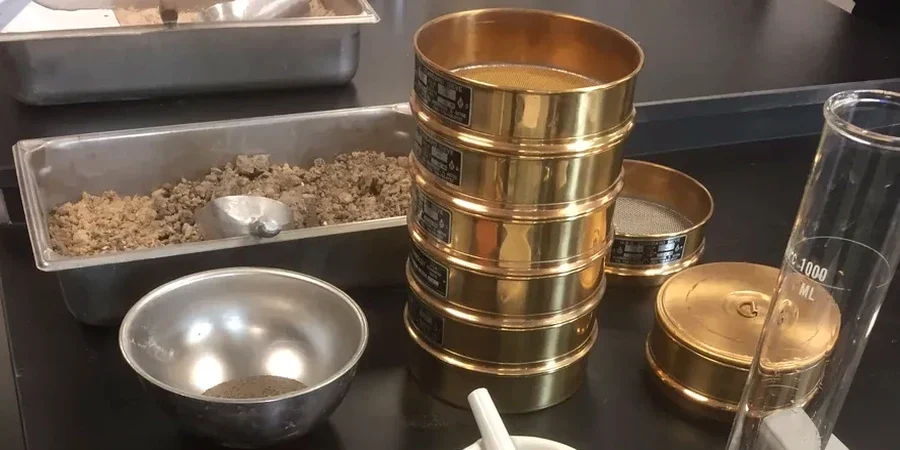
Sample PreparationOven-dried, pulverized to pass No. 40 sieve; wet method for soils with organic content

Questions and answers

How much does Atterberg limits testing cost for a Lexington project?

Standard Atterberg limits determination — including liquid limit by multipoint Casagrande cup, plastic limit by thread-rolling, and plasticity index — typically falls between US$50 and US$90 per sample. The exact cost depends on sample condition, whether the material requires wet preparation (common in organic silts from the Inner Bluegrass), and whether the test is bundled with a full particle-size analysis. Rush turnaround may carry a surcharge.

What is the difference between liquid limit and plastic limit?

The liquid limit is the moisture content at which a soil transitions from a plastic to a liquid state, determined by the Casagrande cup method at 25 blows. The plastic limit is the moisture content at which the soil begins to crumble when rolled into 3.2 mm threads. The difference between the two — the plasticity index — defines the range of moisture over which the soil behaves plastically. A PI below 10 indicates low plasticity silts; above 30 suggests highly plastic clays common in Lexington's weathered shale residuum.

Why are Atterberg limits important for foundation design in Kentucky?

Kentucky's residual soils, derived from limestone and shale weathering, exhibit significant shrink-swell behavior that directly affects foundation performance. The plasticity index quantifies this potential: soils with PI above 25 typically require moisture-controlled backfill, deepened footings, or lime stabilization. The Kentucky Building Code (IBC-based) requires soil index properties for all structures in expansive soil zones, and Lexington's karst geology places much of Fayette County in this category.

Which ASTM standards govern Atterberg limits testing?

ASTM D4318 is the primary standard for determining liquid limit, plastic limit, and plasticity index. Soil classification using these results follows ASTM D2487 (Unified Soil Classification System), which employs the Casagrande plasticity chart to assign group symbols. For Kentucky Transportation Cabinet projects, the companion AASHTO T 89 and T 90 methods may also apply, though they are technically equivalent to the ASTM procedures.

How many samples should I submit for reliable Atterberg limits on a single site?

For a typical Lexington building site, we recommend a minimum of three representative samples from each distinct stratum encountered. The residual soils overlying the Lexington Limestone can transition from CL to CH within short vertical distances, and a single determination can be misleading. For linear projects such as roadway subgrades, spacing samples every 500 feet along the alignment, with additional samples at obvious soil color or texture changes, provides defensible classification coverage.

Location and service area

We serve projects in Lexington and surrounding areas.

View larger map