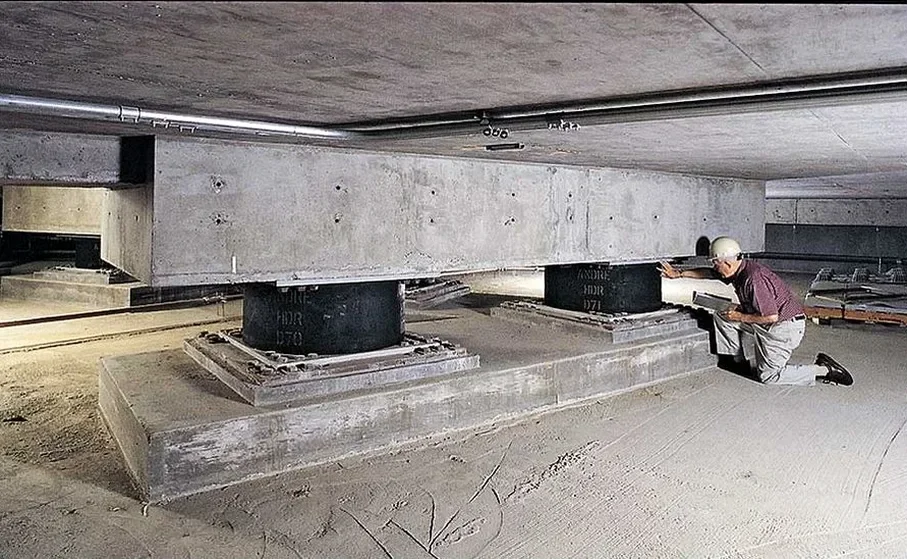
Lexington sits at 978 feet elevation atop 300 to 500 feet of Ordovician limestone. That bedrock has weathered into deep residual clay pockets across Fayette County. The 1980 M5.1 Sharpsburg earthquake shook central Kentucky hard enough to crack masonry at Transylvania University. Our team applies base isolation seismic design when a building's function demands post-earthquake operability. The strategy decouples the superstructure from ground motion. We model site-specific spectra per ASCE 7-22 Chapter 11. Soft clay over pinnacled rock creates amplification. A fixed-base design on this profile would transmit short-period energy straight into the frame. Isolation cuts that. We combine the system with a seismic microzonation study to map impedance contrasts across the site, and use CPT soundings to get continuous profiles where SPT refusal is erratic.
Base isolation shifts the structure's period from 0.3 seconds to over 2.5 seconds—well past the peak spectral acceleration for Lexington's deep soil sites.