GEOTECHNICAL ENGINEERING
LEXINGTON
HomeSlopes & WallsActive/passive anchor design

Active and Passive Anchor Systems for Deep Excavations in Lexington

Evidence-based design. Reliable delivery.

LEARN MORE

Anchor design in central Kentucky carries a unique set of challenges that go beyond standard pullout capacity equations. The interaction between the bonded length and Lexington's karstic limestone—where solution cavities and pinnacled rockhead are more common than most engineers assume—means a simple assumption of homogeneous rock mass can lead to dangerously optimistic bond stress values. Our team works directly with the 2024 IBC and ASCE 7-22, cross-referencing ground investigation data from CPT testing when overburden characterization is critical, and we rely on triaxial testing to confirm the shear strength parameters of the residual clay that often governs the load transfer at the grout-to-ground interface. The Ordovician limestone that underlies much of Fayette County weathers into stiff red-brown clay with variable slickensiding, so anchor design in Lexington must account for both the short-term undrained response during lock-off and the long-term drained condition after the excavation is complete.

In Lexington's karst limestone, the unbonded length must be long enough to keep the bond zone past any pinnacled rockhead, or the anchor will wedge prematurely and the lock-off load will be lost.
Our service areas

How we work

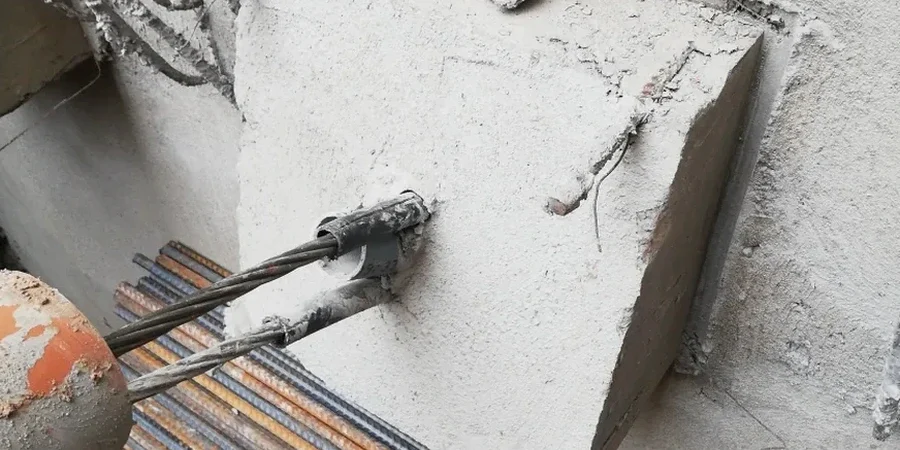
The anchor systems we deploy for projects in the Lexington area are typically double-corrosion-protected (DCP) bar or strand anchors installed with a rotary-percussive duplex drilling method that allows us to advance through mixed ground without flushing fines into open karst features. When the overburden consists of the Grier Limestone member residuum, we often specify a post-grouting program using a tube-à-manchette system to fill any voids intersected during drilling, which directly improves the bond zone uniformity. Load cells and telltales are embedded at the head and along the tendon for staged excavation projects near Main Street or the University of Kentucky campus, where deep excavation monitoring provides real-time feedback on load distribution and allows us to validate the design assumptions. The lock-off procedure follows PTI DC35.1 recommendations, with a lift-off test performed on every production anchor to confirm the residual load matches the design value before the next excavation lift proceeds. For permanent installations, we encapsulate the anchor head in a grease-filled cap and cast it into a reinforced concrete block that ties into the retaining wall drainage system.
Active and Passive Anchor Systems for Deep Excavations in Lexington
Technical reference — Lexington

Local geotechnical context

The most expensive mistake we see in Lexington excavations is specifying an active anchor with an unbonded length that is too short, placing the bond zone within the highly weathered upper limestone rather than in competent rock below the pinnacle zone. When the excavation is cut and the anchor is stressed, the grout column wedges against an irregular rock socket and the tendon elongates only partially—the load cell shows lock-off, but the actual force transferred to the wall is far lower than the design assumes. This scenario has caused wall deflections exceeding 2 inches on more than one downtown project, requiring emergency tieback installation and costly remediation. A second common failure mode arises when permanent anchors are installed without adequate corrosion protection in the fluctuating groundwater zone typical of the Lexington Limestone aquifer. The slightly acidic groundwater, with pH values occasionally dropping below 6.0, attacks unprotected steel within a few years. We specify DCP encapsulation for any anchor with a design life beyond 24 months, and the sheathing continuity is spark-tested at 15 kV before the anchor is accepted.

Need a geotechnical assessment?

Reply within 24h.

Email: contact@geotechnicalengineering.biz

Regulatory framework

ASCE 7-22 Minimum Design Loads and Associated Criteria for Buildings and Other Structures, IBC 2024 Section 1810 — Anchors and Tiebacks, PTI DC35.1 — Recommendations for Prestressed Rock and Soil Anchors, ASTM A416 — Standard Specification for Low-Relaxation, Seven-Wire Steel Strand for Prestressed Concrete, ASTM C109 — Standard Test Method for Compressive Strength of Hydraulic Cement Mortars

Reference parameters

ParameterTypical value
Design standardASCE 7-22 Chapter 15, IBC 2024 Section 1810
Anchor typeActive (prestressed) bar or strand / Passive (fully grouted) bar
Corrosion protectionClass I (DCP) for permanent; Class II for temporary
Bond length in limestone3.0 to 4.5 m (10 to 15 ft) minimum, depending on rock quality designation
Proof test load1.33 × design lock-off load per PTI DC35.1
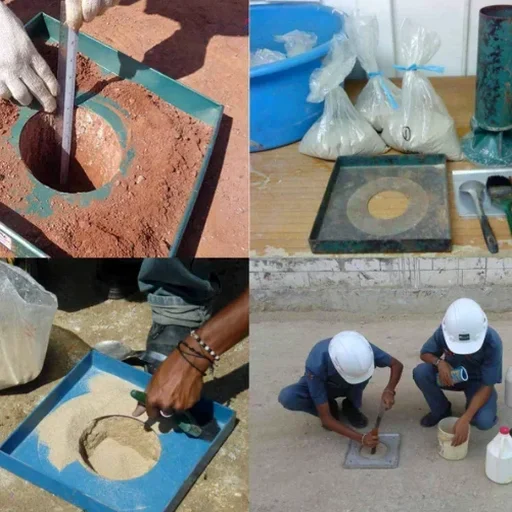
Grout cube strengthMinimum 3,000 psi at 7 days, tested per ASTM C109
Tendon steel gradeASTM A416 Grade 270 (low-relaxation strand) or ASTM A615 Grade 75 (bar)

Questions and answers

What is the difference between an active and a passive anchor, and when do I use each?

An active anchor is prestressed to a design lock-off load—typically 60% to 80% of the ultimate tensile strength—immediately after installation, so it actively restrains the wall from the start of excavation. A passive anchor is fully grouted but not stressed; it only develops resistance as the ground deforms and loads the tendon. In Lexington's stiff residual clays, we generally specify active anchors for soldier pile and lagging walls where immediate lateral support is needed, while passive anchors are more common in permanent soil nail walls on shallower cuts where gradual load development is acceptable.

How much does a typical anchor installation cost in Lexington?

For a standard 4-strand active anchor with double corrosion protection, installed 30 to 50 feet deep in mixed overburden and limestone, the all-in cost—including drilling, grouting, materials, testing, and documentation—typically falls between US$960 and US$3,260 per anchor. The range depends heavily on access conditions, whether casing is required through overburden, and the depth to competent rock, which varies significantly across Fayette County due to the irregular karst surface.

What acceptance criteria apply to anchor testing per current standards?

Under PTI DC35.1, every production anchor must pass a proof test at 133% of the design lock-off load, with the load held for a minimum of 10 minutes while we monitor creep. The acceptance criterion is that the creep movement between the 1-minute and 10-minute readings must not exceed 1 mm. Additionally, the residual load measured during the lift-off check after lock-off must be within 5% of the specified lock-off load. Performance tests on sacrificial anchors go to 167% of design load and are required when the anchor type or ground conditions are being used for the first time on a project.

Location and service area

We serve projects in Lexington and surrounding areas.

View larger map