GEOTECHNICAL ENGINEERING
LEXINGTON
HomeGround improvementGrouting design

Grouting Design Services in Lexington, KY

Evidence-based design. Reliable delivery.

LEARN MORE

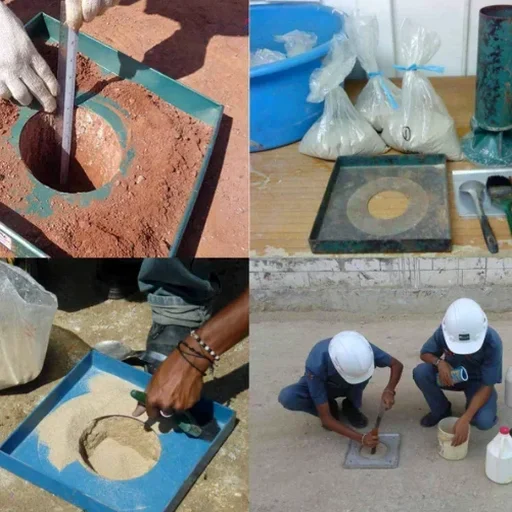
Lexington sits squarely on karst limestone, and anyone who has broken ground here knows the challenge. Cavities, fractured bedrock, and unpredictable voids turn routine excavation into a high-stakes operation. A solid test pits investigation often reveals the extent of the problem before we ever mix a batch of grout. Our grouting design tackles these conditions head-on, specifying permeation or compaction grouting programs that fill the gaps and stabilize the formation. We have managed injection campaigns beneath horse farm expansions, industrial warehouses off New Circle Road, and municipal stormwater structures where the rock was more honeycomb than solid. The goal is always the same: a treated zone that carries design loads without settlement surprises. Complementing the design with CPT testing helps refine the grout take estimates and confirms the treatment radius in real time.

In karst, grout takes are not a cost overrun; they are a sign the design is working as intended.
Our service areas

How we work

Every grouting design we produce aligns with IBC Chapter 18 and ASTM D1586 for subsurface data, ensuring the pressure limits and mix rheology match the actual ground conditions. In Lexington, the Ordovician limestone can vary from massive to highly vuggy within 50 lateral feet. Our approach defines target grout volumes, injection pressures, and stage sequences that avoid hydrofracturing while achieving the required permeability reduction. The design package includes a detailed QA/QC plan with verification drilling and falling-head tests, often cross-referenced with in-situ permeability baselines we establish before treatment.

We work with microfine cements, chemical grouts, and balanced-stable mixes depending on the aperture size of the fractures. For deep foundations near the Kentucky River palisades, we routinely integrate grouting with piles design to handle both bearing and lateral stability in karst profiles. The IBC mandates a unified approach, and our team has applied it across dozens of downtown infill projects where existing structures flank the injection field.
Grouting Design Services in Lexington, KY
Technical reference — Lexington

Local geotechnical context

Fayette County records over 250 documented sinkholes, and the Kentucky Geological Survey maps significant karst potential across 60% of the county. Skipping a grouting program in a mapped karst corridor invites differential settlement that insurance rarely covers. We have seen column-supported slabs tilt when an undetected cavity opened beneath a single pile cap; the repair cost tripled the original grouting estimate. Our design mitigates this by requiring pre-production probe holes and real-time pressure monitoring, which catches anomalies before the grout escapes into a larger conduit system. The biggest liability is not the grout itself but assuming the ground is uniform when every borehole in Lexington tells a different story.

Need a geotechnical assessment?

Reply within 24h.

Email: contact@geotechnicalengineering.biz

Explanatory video

Regulatory framework

IBC Chapter 18 – Soils and Foundations, ASTM D1586 – Standard Penetration Test (SPT), ASTM D2487 – Unified Soil Classification System, ASCE 7 – Minimum Design Loads for Buildings

Reference parameters

ParameterTypical value
Typical grout mix range0.6:1 to 0.8:1 water-cement ratio
Maximum injection pressure50-150 psi (overburden-dependent)
Verification standardASTM D1586 SPT before/after treatment
Permeability target1 x 10^-5 cm/s or project-specified
Hole spacing (primary grid)5 to 10 ft triangular pattern
Applicable IBC requirementChapter 18 – Soils and Foundations

Questions and answers

What does a grouting design package from your team typically cost?

Depending on the complexity of the karst features and the number of injection stages, a complete grouting design for a Lexington site ranges from US$1,240 to US$4,420. That covers the work plan, mix specifications, QA/QC procedures, and one round of field adjustments.

Can grouting eliminate all sinkhole risk in Lexington?

No design can guarantee zero risk in active karst. What a well-executed grouting program does is reduce the probability of sudden collapse by filling interconnected voids and strengthening the rock mass. We combine the design with a long-term monitoring recommendation to catch any new dissolution activity early.

How do you verify that the grout has filled the intended voids?

We specify a combination of SPT refusal testing, core recovery comparison, and water pressure tests before and after injection. If the post-grouting permeability does not meet the target, we adjust the secondary hole pattern and repeat the verification cycle.

Is microfine cement always necessary in Lexington limestone?

Not always. Microfine cement is effective in hairline fractures below 0.5 mm, but many Lexington formations have larger solution channels where standard Type III cement with a balanced-stable mix performs well. We select the material based on aperture data from the pre-design investigation.

Location and service area

We serve projects in Lexington and surrounding areas.

View larger map